
01 July 2021

“It’s a planet,” I said. “It’s not what we thought it was back home. It’s not this safe cocoon, man. We’re out here spinning in all this chaos. The Earth is a planet. The Earth is a spaceship, and we’re all space travelers.”

06 June 2021
Ahead of the release of Netflix's "Trese" adaptation, I decided to pull these out of my bookshelf and re-read these graphic novels on Philippine mythology. Coming to terms with the myths in our culture is imperative. So many of these stories were passed on to us orally by the older generations, but to most, they remain just that: old tales. What some fail to grasp is that they are reflective of our ancestors' beliefs and identities. Our forefathers devised these as a result of their unique and collective experience as a people who traveled, migrated, and traded throughout the Austronesian archipelagos. What seems to be fantastical and unrealistic was, to them, logical and compelling. And while rediscovering our myths does not mean that we must believe in them the very same way our ancestors did, it should give us a better understanding of our history and make us appreciate how our pre-colonial forebears survived — and even thrived — because of these.
31 March 2021
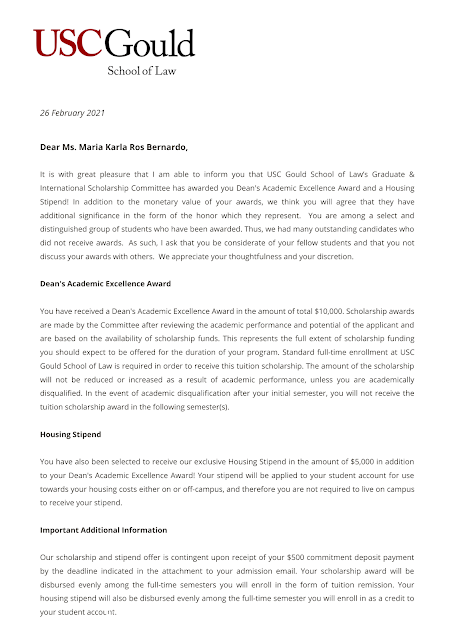
Because of the ongoing pandemic (and last year's deferral), I decided to take my chances and apply to other universities for my LLM, despite believing that some of them may be quite a reach. While my heart was set on going to UNH Franklin Pierce because of its consistently top-ranked and renowned intellectual property law program, a part of me also wanted to see if I had a shot at other schools, if only to explore other options and satisfy my need for affirmation. (Insert insecurities caused by law school here.)
Realistically, I wanted to apply to California law schools because I might have a chance of defraying costs, considering the relatives living there. I have an aunt in San Francisco and we have close family friends in Los Angeles. I greatly enjoyed my last visit in 2017 and have always felt like I belonged more to the sunny West Coast.
But deep down, I wasn't sure if I'd even get in these schools. It's no secret that I did not excel that much in law school grades-wise, and I had a hard time coming to terms with that. Typical law school story: I was a consistent honor student from grade school to college, so to find myself in a place where everyone was so much better, the environment wasn't as encouraging, and the subjects were so terrifying certainly took some adjusting. But of course, I did manage, and I did survive. I found great, supportive, life-long friends (in my sorority, my block, and in different batches) who helped me hurdle four-and-a-half years.
And I did eventually stumble into a field I enjoy, enough that I now think I'm deserving of pursuing higher studies in it. Ha! Me, wanting to study more law? Crazy how it all turned out.
I'm happy to share that I got zero rejections in all the schools I applied to. I got accepted to University of Southern California, University of California Davis, and University of California Hastings. Even better, I was offered merit scholarships / Dean's Academic scholarships in all three law schools. To say that I was shocked would be an understatement. Me??! How did this happen!
In addition, I got waitlisted at UC Berkeley and UCLA, schools where I was a hundred percent sure that I will be rejected. I kept telling myself, before pressing the "Submit" button on LSAC, "Sayang lang application fee ko dito." For real. I could not believe that my application was even strong enough to merit being placed on the waiting list for these universities. I didn't get rejected! What!
(I also got accepted to Loyola Law School and Santa Clara University last year. Yay, Jesuits!)
My grades in law school were not stellar, but I'd like to believe that I made up for it with my "softs" - work experience, internships, and strong application letter. During law school, I actively pursued internships during the summers, including work for the Regional Trial Court and the Supreme Court. I'm certain our fourth-year internship for the UP Office of Legal Aid (OLA) and externship for the Office of the Government Corporate Counsel (OGCC) helped as well. This, on top of my work experience that focused specifically in IP and media law, and my teaching experience.
Perhaps more significantly, in my personal statement, I made sure to highlight my affinity for arts and literature. It was the reason why I mainly wanted to pursue IP. Outside law school and in practice, I kept writing, had a few articles published in magazines and newspapers, and continued to explore this pursuit. I honestly think this helped make my application stand out because it showed an aspect of me beyond academics. It also reinforced why I wanted to pursue an LLM in IP: I honestly wanted to make a significant impact in the Philippine literary, artistic, media, and entertainment landscape.

11 February 2021

My third anniversary in the office is coming up (tomorrow, to be exact), and it just dawned on me that I haven't exactly written about my work life. Not in my old blog, and not even in my personal journal. I've shared snippets of it on Twitter, my LinkedIn profile is pretty transparent, and surely most people in my circles are aware of the kind of work I do. But it never really occurred to me to really write about what I do for a living - and more importantly, why.
I suppose it's mostly because I don't want to come off as pretentious. People who only talk about their work can come off as insufferable. Especially when they claim to be experts at what they do. And I still feel like there is so much I don't know, so what right do I have to be writing about it?
Then again, it's not as if I'm going to be throwing out random legal advice into the ether. Describing the job - and really thinking about why I'm in it - is certainly worth making some room for, even in my small corner in the digital space. After all, it's almost three years now. Milestones are milestones, and they're worth writing about, aren't they?
Being in intellectual property wasn't something I planned on before I entered law school, and it wasn't even something I considered in law school. Before my fifth year of law, I was dead set on applying at the Supreme Court, particularly in the office of then-Chief Justice Sereno, where I interned that previous summer. But we all knew how things turned out, and by the time I finished taking the Bar, they were no longer taking in new applicants, given the uncertainty of the situation. As such, I was forced to consider the more "traditional" route, i.e. firm life.
I did enjoy IP in law school, in large part due to my professor (and one of our sorority's most esteemed alumni). Something about it made sense to me, mostly due to my undergrad. CAL taught me to value the artistic and creative integrity that comes with each piece of art, innovation, or technology. And considering that I was in deep denial about no longer being a literature major for the entirety of law school, taking this path felt like coming home in many ways.
My law school thesis was actually on fair use. And the topic was serendipitous, in that, all the pieces wouldn't have come together had it not been for my background. One desperate, fateful night in 2016, just a few hours before the deadline for submission of initial thesis proposal topics, I came across several Facebook posts (and links to some blog posts) about an ongoing copyright issue with one writer and one local publishing house. (The writers on both sides included professors from our department.) It was a very interesting, unique, and novel issue on copyright, fair use, criticism, and appropriation of literary works, and one that I had a unique viewpoint from which to see the action.
Two years later, it got published in the Philippine Law Journal. And that very same thesis also landed me my current job. During my interview, one of the partners asked me about my thesis. It caught me a bit off-guard, since none of the firms I previously applied for asked about it. I went into great detail about the topic, arguing passionately for the writer/artist. In another twist of fate, turns out, this law firm represented the publisher! I was so sure I would not get the offer, considering my stand. I walked out of there thinking, "Okay time to search for other IP firms!!!" But I got invited to a second interview, and was eventually given an offer.
And now here we are. To borrow from another great KB (Kate Beckinsale, in Serendipity): a fortunate accident.
Since then, I've handled cases on copyright, trademark, and patent enforcement and litigation. I am also assigned work that deals with the policy aspect of intellectual property. We assist in the drafting of university and institutional IP policies and agreements, as well as give advice on certain government-funded technology projects. I also do contract reviews and provide legal opinions on franchising and licensing agreements, artist/producer/director contracts, and other IP related matters. We handle local and foreign clients, and we provide opinions on a variety of novel issues. You'd be surprised at how much IP intersects with a lot of other fields.
Last November 2019, I was selected by my firm as a delegate for the Licensing Executives Society (LES) Young Members’ Circle Asia-Pacific Conference in Seoul, South Korea, where I learned more about global licensing particularly on beauty, healthcare, telecommunications, big data, artificial intelligence, and entertainment. It was such a privilege to have been selected to attend that short conference. I got to meet other IP practitioners from Manila, and all over the world. But I'm not going to lie, my favorite part of the whole thing was the fellowship with other attendees. We all went to a cozy, underground jazz bar and drank all night. (All while trying to squeeze trite trademark-related jokes in between.) It was a blast.
Something I'm most proud of during quarantine was being part of the Technical Working Group in the Supreme Court that worked on the amendments to the Rules of Procedure on Intellectual Property Rights Cases. One of our partners was part of the TWG, and he tagged me along. Before the start of the pandemic, we would regularly attend meetings at either the IPO or the SC. And during quarantine, we had bi-weekly Zoom meets to discuss, go through, and align all provisions and proposed amendments. Since my boss was the expert private practitioner in the group (even the justices deferred to him on some matters), we worked double-time on ironing out the kinks, while consulting other laws and even rules from other jurisdictions. And yes, even on weekends. But it was so satisfying because it felt like a significant contribution to the practice. I have to admit, I cried a bit when the Rules were finally published on the newspaper. My name wasn't there (my boss' was though), but deep down, I was like, "I helped!!!"
And just this week, our boss again tagged me along to join him as part of a TWG in Congress, this time for the amendments of the IP Code itself. I can anticipate a pretty long, gruesome, and thorough process again. But it all sounds exciting.
Exciting. I guess that's the important keyword right? The last twelve months have been stressful as f*ck. For about two-thirds of 2020, we were only two associates. (Two resigned pre-pandemic.) There were days when I'd literally cry myself to sleep, then cry myself awake. Highly unusual for masandal-tulog, parang-mantika-matulog me. But... I don't know. I still very much enjoy the work. As much as I hate litigation (I really do; but my frustrations about it are for another post altogether), I still like everything else I'm doing.
I like doing what I do. Which isn't saying a lot for most people. A friend once told me that your mission is where your deep happiness meets a deep hunger of the world. I don't know if I'm at a point in my life where I can say that about being a lawyer. Or this practice, even. The truth is, I've never fallen in love with lawyering the way everybody - including myself - expected. I crawled my way out of law school, desperate for affirmation, lost as to purpose. But somehow, surprisingly, I managed to find a good, comfortable place that I actually like. Me, liking the intricacies of the law? Who would've thought? Maybe I'll be elsewhere years from now. Maybe I'll come across a field or a job that is truly representative of all my interests (and that does not involve appearing in court). Maybe not. But right now, I still like this.
And maybe that's a good thing.

26 January 2021
 |
| (Say hello to my Kobo Glo HD, a New Year gift to myself) |
“You can write it all down, you can put it in your book of facts, but the truth is no one can ever really understand the tangle of experiences and passions that makes you who you are. It's a secret collection, a private language, a pebble in your pocket that you play with when you're anxious, hard as geometry, smooth as soap.”
I don't think I have highlighted and bookmarked a book as much as I did this one, at least in recent memory. So many passages I wish I could press onto my skin, words I truly wanted to physically carry with me every single moment if I could, like a neon sign that says, "Yes, this is how I feel." Raphael Bob-Waksberg's short story collection is a brilliant, unique, weird, and absolutely enjoyable ride. I read it in two days.
I loved BoJack Horseman. I loved it so much I don't think I can watch it again any time soon. The way the story unfolded was so painful, realistic, and dark. But it was the perfect encapsulation of human fragility. And human resilience. We all just want to keep trying to be better versions of ourselves. And that includes accepting the worst parts of us too.
This sentiment is carefully crafted into each of the stories. That feeling of hope: hope that the wounds of past loves heal, hope that we can learn from our mistakes, hope that we find meaning again, hope that love sustains. Even when it's heartbreaking, it's uplifting.
So unlike the show, this is definitely something I want to go back to again and again, to read when I'm sad or happy or when I feel like I need to be reminded of how beautifully devastating and fleeting life is.
"Every other night will have been rehearsal for Friday 18 July - we had to be ready. Everything was pushing us imperceptibly toward this moment - if I hadn't missed that train, if you hadn't moved for the job, just imagine."
The best stories in the collection were those that leaned toward the more absurd, almost science fiction. Bob-Waksberg has a very careful hand when it comes to ludicrous premises. He's done it successfully in BoJack Horseman, and he's an even better architect of it in fiction. The surreality of these stories is heightened by the fact that they're being told with a straight face: here's an AntiDoor to a different universe which you can step into during your lunch break. Oh, just another day of planning a wedding with twenty-eight sacrificial goats. A band with a slightly modest following is forced to choose between touring Portland or staying in San Francisco, and oh, by the way, they have superpowers. Two people who found each other on a train but never spoke to each other for six decades. It's all so crazy, and yet, it's precisely the right amount of crazy that amplifies just how vulnerable and foolish we are as humans. It won't change. Put someone in an otherworldly dimension, a world so completely different from their own, and you can expect them to be themselves.
No circumstance is so bizarre that it will force you to become someone you aren't - in fact, you will turn out to be exactly who you are.
"And I think about how loving someone is kind of like being president, in that it doesn't change you, not really. But it brings out more of the you that you already are."
Thirty-one pages in and I was already crying my eyes out. A little spoiler alert: the fourth story, about a missed connection on a train, really hit home. I've never personally experienced that, but I think the many heartbreaks in our family certainly revolve around those feelings. Of missed chances, of having spent a lifetime with a person and still not knowing them. Another story, about jumping into an alternate universe and meeting a different version of your beloved, was quite compelling too. It was an exercise in futility, an abstraction of curiosity and guilt. It's about pushing the limits of what a transgression can be, using regret (or the lack thereof) as the compass. It's fascinating and heartbreaking. You know where it's going, but just like the character, you still have to go through with it.
"But no, you were gone. And I realized most likely I would never see you again. And I thought about how amazing it is that you can know somebody for sixty years and yet still not really know that person at all."
A lot of the other stories in the anthology contain that same eagerness to just live through it. Pain and misery are just around the corner, but who's to say that's the only thing waiting for you? The first story is actually a great metaphor for this entire premise. A man gives a woman a can of cashews. She knows from her past experiences that it can be a practical joke: open it and a spring-loaded snake will jump at her. And yet, and yet. He promises that it will be different. The canister says it will be cashews. Her heart wants to trust the moment but her memories say otherwise. It's a tug-of-war between going for it and walking away. But one thing that is absolutely clear however - she wants to.
This book is mostly about the wanting. Some characters follow through with it, most of them don't. In the end, they are defined by the choices they made when the universe - bizarre, and absurd as it was - led them to a fork in the road. And while it can be terrifying to look at life this way (Will I forever be haunted by the weight of every decision??), there is also a kind of liberation that comes with it. That there are so many opportunities to be brave, to take a U-turn, to change course. There's always room to move forward.
"But if there’s a silver lining here (and you’re not sure there is one), it’s the assurance that what you had, whatever it was, had weight. It made an impact. You can put to rest the fear that you were a blip in this other person’s life, a footnote. What you did was important. You hurt somebody, and somebody hurt you."
But it's not so bad to look back, fondly embrace the past, and burrow in the weird, dull, aching satisfaction of remembering.
"And I thought about how, actually, if you wanted to, you could say the same thing about life. That life is terrifying and overwhelming and it can happen at any moment. And when you’re confronted with life you can either be cowardly or you can be brave, but either way you’re going to live.
So you might as well be brave."
(P.S. This is actually already my fifth book for the year! Yay, resolutions, progress, yadda yadda.)

21 January 2021

"When day comes, we ask ourselves
where can we find light in this never-ending shade?"
I had no intention of staying up until two in the morning to finish checking final exam papers, but I tuned in to Joe Biden's inauguration and decided to watch until the end. Something about going through my students' answers on legality, moral justification, Dworkin's hard cases, and MLK's nonviolent direct action made me realize how important it is to be reminded that for our institutions to work, we must not lose sight of people. Actual people. Citizens are not some abstract concept — our laws affect us directly. Words have a tangible effect on us. When leaders see their constituents as humans, rather than mere pawns, change - the good kind - can happen.
*
I've had the privilege of being invited to teach at the University of Makati School of Law last semester. I taught Philosophy of Law to wide-eyed and eager first years. I was just as eager. More than just teaching them the law, I felt it was important to impart the wisdom behind it — especially given everything that's happening. Why do we need it? How can it be used for the greater good? And to what extent should it shape our lives? A lot of people treat the law as merely a weapon: it has the power to command, to sanction, to delineate. But, again, in practice, when you go to the courts, and you see actual people on the receiving end of these words, you realize that these laws don't exist in a vacuum. They affect people in a real way. When drafted haphazardly or when applied irresponsibly, it is incredibly damaging. But when used for good, it can help heal.
The class was receptive and responsive to these concepts, mostly because of their diverse backgrounds. The block had a former criminology student, a radio journalist, working parents, media practitioners, government employees, accountants, members of the LGBT, fresh college graduates, breadwinners — all walks of life, from different parts of the country. It was a good learning experience for me as well. I discussed the readings I assigned through the lens of my own experience. But most of them were able to process them through interesting and more meaningful angles. Listening to their perspectives every meeting was confirmation that the profession thrives with diversity. The law is enriched when we consider the input of people coming from different backgrounds. Finding a more equitable common ground is only possible when we consider the concerns of many, and not just the select few.
Most striking to me, though, was how earnest they seemed in just wanting to be good and to do good. Since the time I graduated from law school, things have gotten much worse. And I cannot imagine the exhaustion and hopelessness they must feel having to learn about these concepts at a time like this. Instead of feeling discouraged, however, I felt the desire — even the desperation — to want to do well so that they can contribute in some way, somehow, in the future. Discussions with other faculty members also echoed the same sentiments: they're really trying. The dire circumstances of this administration weigh heavily on all of us. Everyone is suffering and being apathetic is just not going to cut it. If there's a silver lining to all this, it's that more and more people are realizing that things have to change. And they want to play a part in doing that.
*
I read Joe Biden's book, "Promise Me, Dad," last year, mostly in the dark, during a power outage caused by a typhoon. To be honest, I had no real investment in his campaign or career prior to that. And even after having read it, I don't think I have a complete picture of who he is as a politician. (It is, after all, a memoir, so much of the narration has to be taken with a grain of salt since he's telling his version of events from 2013 to 2015 — of course, he had to downplay some conflicts and play up others.) The book covered only a very limited period of his life: during the last few years of his vice presidency, when he was dealing with his son Beau's cancer diagnosis, handling matters regarding Iraq, Russia, and Crimea, and considering whether he was going to run for the 2016 presidential elections. But it was a good distillation of who he was, essentially: a person who has grappled with sorrow and defeat — many times and in many ways.
Biden survived the death of his first wife and baby daughter, raising his two toddlers who survived that car crash, losing Democratic primaries, not being endorsed by the President, and having his eldest son succumb to cancer. He had to loan from Obama for his son's medical bills, he overcame a stutter as a child, he was not a particularly excellent law student (#relate). He wasn't, by any means, a brilliant guy. Maybe I'll always have a bias towards people who have swum through the depths of grief. Maybe I'll always wear grief on my sleeve, or like a small flag brooch pinned to my emotional lapel. But there's a reason for me to believe that he is likely to lead well because he's no stranger to struggle. He knows how to listen. He certainly can't change US politics (their history is much too tarnished for any one person to ever change their legacy). And we still need to be vigilant about how their policies greatly impact other countries, including our own. But in times like these, even though the bar is so low, his capacity for compassion isn't such a bad thing.
I really wish the Philippines follows suit soon. The shamelessness, the duplicity, the corruption of this administration in the middle of a pandemic — it's sickening and terrifying. I can't wait for us to see the light at the end of the tunnel. It still seems so implausible. But I can't help but feel hope. We have to. It can't be that far off, can it?
*
Triteness notwithstanding, I honestly believe that the most important thing to teach law students is the notion that knowing the law places you in a position to help. Ironic, since law school tends to attract the self-absorbed, pompous, power-hungry types. But it shouldn't be that way. And even if it were, it should change their perspective.
It was serendipitous that I got assigned to teach that subject. Preparing the syllabus meant I had to go through different readings and reacquaint myself with these concepts again (which, if we're being honest, slipped through the cracks of my mind when I was taking this subject in my first-year law). While the teaching environment this semester was challenging, it also opened more opportunities for me to converse with students in a less stringent way. During the first day of class, most of them were honest about their personal struggles, as well as their feelings of intimidation regarding a philosophy subject. But it was encouraging to me that these students responded well to the syllabus, and that, as shown by their performance in class, they were able to grasp early on that the stability of our institutions depends on how well our laws are upheld and to what extent they bend towards justice and equity.
*
The rest of the climb still seems steep and daunting. I honestly don't see 2021 being that much different from 2020. It will take years, maybe decades, before the damage of bad leadership is undone. (Duterte is a monster.) But hopefully, it will come sooner than later. I have to trust that it will happen if only to keep myself afloat. Teaching certainly helped: if I could instill that in my students, I could certainly make myself believe that too. And if they can make me believe that there are so many people out there who want to learn more to be able to do more good, then there's reason to hold out hope.
Wishing that the words by Amanda Gorman, the young 22-year-old poet laureate who spoke during the inauguration, can serve as both a compass and an affirmation:
"But while democracy can be periodically delayed,it can never be permanently defeated.In this truth, in this faith, we trust."— The Hill We Climb by Amanda Gorman
(P.S. And here's to hoping it will take the art, the poetry, and the optimism of the young — our generation — to steer us towards better days too.)

31 December 2020

"The culture is lit and if this is it, I had a ballI guess that I'm burned out after all."
— The greatest, Lana Del Rey

13 December 2020

Conan O'Brien Needs A Friend, Episode 13: Stephen Colbert |
Stephen: "I had a magical thinking about suffering and about forbearance and patience. Patience and forbearance of suffering. It would require enormous magic for that not to have happened [to my dad and brothers]. But what kind of brother or son would I be if I didn't at least attempt the magic?"
Conan: "I grew up an anxious person, very anxious person, and struggled with anxiety, and I really thought in a Catholic way that everything anything good had to come through suffering. I really believe that you have to be miserable."
Stephen: "I'm a Roman Catholic, and an 11-year-old altar boy. Very devout household. And the image of Christ on the cross - the highest aspiration is to be able to take up your cross and to alchemize suffering into gold. But you can't have gold without suffering. To the point where I had a magical thinking."
Conan: "I felt like I suffered through other things, and they felt very powerful to me. And I engaged in magical thinking and put myself through a lot of torture. And here’s the crazy thing what happens when you do that, and then magical things start to happen for you."
"The magical thinking magically thinks that the magical thinking worked."

28 November 2020
 |
| First Women by Kate Andersen Brower; Tough Enough by Deborah Nelson; Rodham by Curtis Sittenfeld |
These are the last few books I've just finished, and it only took me about a week and a half to go through all three. Maybe it was because of my eagerness to reward myself after two consecutive hearings, or maybe it was my bias towards books that concern strong women. The running theme seemed to be women orbiting close to power, but also, to painful realities. Riveting.
1 | "First Women: The Grace and Power of America's Modern First Ladies" by Kate Andersen Brower
The first lady has no place in the Constitution; she has no official duties other than to be the President's wife. But it's certainly interesting how they carved their own paths separate from, although entwined with, their husband's and how differently they used the platform the presidency gave them. This book is one of the three nonfiction books by Brower detailing some of the most interesting aspects of the US Presidency aside from the Presidents themselves: the first wives, the vice presidents, and the White House. This book focused on the presidential wives starting from Mamie Eisenhower until Michelle.
Instead of providing a separate chapter for each woman, Brower interlaces their stories under specific themes. What surprised me the most was how much the modern first ladies figured in their husbands' politics. Some of the first ladies actively participated in Cabinet meetings, foreign policy discussions, and even stood as diplomatic envoys on behalf of the US. I will admit that before reading this, I was only familiar with Hillary (with whom I share the same birthday) and Jackie Kennedy (whose grief and compelling private life had been closely scrutinized over the years). But this book made me the most intrigued about Lady Bird Johnson, Rosalynn Carter (who founded the Carter Center and Habitat for Humanity), and Betty Ford (who championed mental health and support for alcoholics and cancer survivors by establishing the Betty Ford Center.) Their contributions to society are considered seminal now, but what role would they have played if they were not given the platform of their husband's office?
Another interesting aspect of the book was how older first ladies belonging to a different generation viewed the relatively younger, more ambitious ones. In particular, Hillary Clinton, who, unlike her predecessors, had goals of her own — aspirations outside and beyond her husband's presidency. Some of the older First Ladies — and I suppose, America in general — found this off-putting at the time. But, as the author surmised, it was probably because they recognized the privilege afforded to the women of the succeeding generation. The feminist movement of the 60s and 70s certainly allowed and provided more options for women in their chosen careers. The older first ladies such as Barbara Bush didn't have the same opportunities as, say, Ivy League-educated Hillary, as a circumstance of being born during her time. Perhaps it's not so much disdain, as it is a repressed kind of resentment that they were limited to just being the President's wives as a consequence of living in a different era.
2 | "Rodham" by Curtis Sittenfeld
Which gives us a perfect segue to Rodham. To borrow from Jane Eyre, in this book, reader, she did not marry him. This novel envisions what Hillary's life would have been had she followed her head instead of her heart and turned down Bill's proposal.
Full disclosure that I do not claim to know the entirety of Hillary's politics, nor that of Bill's. I just know that we were both born on October 26, so that's worth mentioning. (Another person born on that date? SC Justice Antonio Carpio. I am in great, powerful company.)
This is actually the first book I've read about Hillary. I initially wanted to dive into "Living History" first, her 2003 memoir, after reading Michelle Obama's "Becoming." But I just didn't feel like reading about all the issues that plagued the Clinton presidency, so I skipped it. According to the reviews I found on this book, it was pretty accurate of her life as a young Yale law student and fresh graduate anyway, so I was really interested in reading about how she was before Bill Clinton — and the rewritten history had she let him go.
I've always wanted to believe in multiple universes, in the possibility that out there are a multitude of lives running simultaneously along with this one, with varying degrees of discongruity. And given the huge losses that Hillary had to take in this lifetime, I couldn't help wishing that the fictional tale in the novel was the real one instead.
The novel felt like a realistic portrayal of who she was: strong-willed, stubborn, ambitious, driven. The book recounts the beginning of their romance but the story certainly takes off after their break-up. Walking away from an engagement with Bill Clinton saved her from a lot of bigger heartaches and moral pitfalls. But it was still rather sad to find out that even in that universe, some things would not have turned out that much differently. Her political life may have taken wilder, bigger turns, but people will still see her as cunning, evil, and aggressive — just because that's how society views women chasing dreams that do not solely prioritize motherhood or marriage. I liked how the novel creatively intersected events that actually happened in real life (in one part of the novel, the "Shut her up!" crowd still shows up, albeit from a different side, but pretty much for the same reasons), which kept the story grounded. It also helped that apparently a lot of scenes in the book mirrored things that Hillary herself wrote about in her previous memoirs or that official biographies narrated. It didn't really tackle her policies and politics though, which prevented the novel from being truly compelling.
In the end, despite it being a fictionalized version of Hillary's life, it gave a decent glimpse of who she is: detached but still sincere, honest about being ambitious but still someone worth empathizing with. In opening the door to an alternate universe, it allows us to envision a reality that does not judge her for her husband's actions. It simply allows us to view her as she could have been, on her own. She may have still made mistakes. But it still could have been different; and in this other reality, different was certainly, infinitely better. If only?
3 | "Tough Enough: Arbus, Arendt, Didion, McCarthy, Sontag, Weil" by Dorothy L. Nelson
This is the most insightful and my personal favorite among the three books. It is not a biography, rather a literary critique of the six women's works.
These thinkers and artists had significant influence on their respective fields: philosophy, literature, photography. One major criticism when it comes to the scholarship on these fields is that there just aren't enough female voices, i.e. they lack emotion and depth. But interestingly enough, the impact of these women did not arise because of this. In fact, they were largely criticized for the absence of sentiment in their approach to their art. The six women discussed in Tough Enough have been, in varying severity, accused of the opposite: being too cold, too unfeeling. Too detached. In going through the trajectory of their careers and most seminal works, the book explores the ways in which a disavowal of sentimentality by female artists, who are most likely to be accused of it, translates to a powerful stance. Informally dubbed as the "school of the unsentimental," the book examines how human nature is better understood when pain and suffering are processed at an arm's length.
For a sentimental person like me, the impersonality espoused by the book is a kind of wish-fulfillment. I have long admired Joan Didion and Susan Sontag, and I understood the effortlessness of their works was what made them cool. I aspired to be like that. Because their voice seemed so uncaring and dismissive in their writing, they were able to crystallize the minutiae of life in more impressive detail. But I don't think I was fully able to grasp that until this book confirmed it for me.
I was most absorbed by Weil's philosophy of "attention" — attention that is stripped of sympathy and empathy. It is an absolute emptying of our selves, our egos, our feelings, our motivations. When one is "attentive," one renounces this active longing in order to receive what the world has to offer, without the interference of one's limited and biased perspective. For Weil, the problem of actively seeking is precisely that one is too eager to fill the void in our soul. As a result, one settles too hastily on something: a counterfeit, a falsity. It is thus crucial that attention be characterized by detachment. Also central to Weil’s ethics of attention is a certain level of disinterestedness, which is thus the only way we could act justly towards other people's suffering. When we are moved by sentiment, we keep putting ourselves in the narrative. This is not the way to act just; rather we must focus solely on the suffering — the affliction — of others objectively. Otherwise, we cannot truly know. And we cannot truly receive.
Nelson focuses on these women's works pertaining to tragedy and suffering: Arendt's use of irony and discussion of "the banality of evil" in Eichmann in Jerusalem, Susan Sontag's response to the September 11 attacks which did not call for unity but rather castigated the politics that led to the event, Mary McCarthy's rejection of empathy and solidarity in favor of confronting the pain of reality in The Company She Keeps, Diane Arbus's photographs of "the freaks" and the outcasts, Joan Didion's deep dive into grief after the deaths of her husband and daughter — these non-expressive, unemotional responses to reality all gave way to an aesthetic grounded in fact. To them, reality was the antiseptic to pain, and this antiseptic leads to true and actual catharsis.
Tough Enough is an important book because it proposes that these six women's contributions to intellectual history challenges the modern insistence on empathy as a panacea to all our political and societal illnesses. Whether or not you agree with the case for "unsentimentality," these women's works were monumental in providing different considerations on how to face suffering. In dealing with suffering without trying to inhabit such a large emotional space, we are challenged to accept that empathy is not the only salve to our collective consciousness while still finding something meaningful in our objective collision with reality.
*
Peculiar, though: none of these books made me cry.1 And yet how fitting, especially considering the last book's appeal to pragmatism. While I wasn't consciously seeking for a theme when I picked up these books, one certainly emerged. To seek out the facts, to make an objective attempt at reality, and to desire the truth, is to create the potential for transformation and action. To be confined to the label of "woman" is certainly a societal flaw that all these women sought to correct. They are embodiments of the female desire to reassess how society views them. They can be many things — caring, detached, emotional, cold, ambitious, facile — all at the same time. It doesn't have to be either/or, and they do not have to be punished for it.
__
1 That recognition belongs to "Promise Me, Dad" by Joe Biden, which I read during the height of typhoon Ulysses. By the time our power went back on, I was crying my eyes out on Beau Biden's passing.
Social Media